July 4 ITC Safe Harbor Deadline: How to Lock in Today’s Eligibility Requirements until 2030

Table of contents
- The Beginning of Construction Date That Determines Everything
- Safe Harbor Through July 4: What Gets Locked In
- Developer Decision Flowchart: Establishing Beginning of Construction
- After July 4: 12 Month or 18 Month Construction Runways
- The Hidden Risk: Competition for Equipment, Labor, and Permits
- The Competitive Reality: This Is How Bids Get Won and Lost
- How SolarEdge + Racking Clears the 2026 Thresholds
- Frequently Asked Questions
- The Bottom Line
Note: Statements regarding tax credit eligibility, domestic content, and non-PFE compliance are based on current interpretations of applicable laws and guidance, which are subject to change. SolarEdge does not provide tax or legal advice. Consult your tax and legal advisors for project-specific guidance.
Every EPC, C&I developer, and asset owner in the solar industry is facing a pivotal moment. The One Big Beautiful Bill Act (OBBBA), compressed the runway for solar eligibility for the section 48E investment tax credit (ITC) (commonly known as the Solar ITC) and set a hard deadline to begin construction: July 4, 2026.
Solar professionals face a supply chain decision that will determine who is best positioned to compete through 2030. Developers who safe harbor inventory (on or before July 4th) or qualify with the Physical Work Test can have ITC savings they can offer to their customers making their bids much more competitive.
Here's what's happening, what's at stake, and how to think about your next move.
The Beginning of Construction Date That Determines Everything
The OBBBA sets a sequence of hard deadlines that leave no room for error. Understanding which scenario applies to your project is the difference between up to 40% ITC and potentially $0.
Step one for qualifying for the ITC is establishing the Beginning of Construction (BOC) date. A taxpayer can establish the BOC date for the ITC either by paying or incurring 5% of the total project cost (5% Safe Harbor) or by performing physical work of a significant nature on site or off site (Physical Work Test), and maintain the BOC date by meeting the continuity requirements, (see IRS Notice 2022-61). The OBBBA requires solar projects that began construction after 2025 to meet the material assistance cost ratio (MACR) threshold to qualify for the ITC.
What is the MACR?
Per legal experts Morgan Lewis: Based on recent IRS guidance (Notice 2026-15) issued in February 2026, the Material Assistance Cost Ratio (MACR) is a crucial compliance metric designed to prevent taxpayers from using clean energy tax credits—including the Investment Tax Credit (ITC) under Section 48E and Production Tax Credit (PTC) under 45Y/45X—if their projects include significant materials or components from a Prohibited Foreign Entity (PFE).
The MACR acts as a "pass/fail" test, determining whether a project or component is eligible for credits based on the percentage of non-PFE content.*
| Beginning of Construction Date | Domestic Content Threshold (10% adder) | Material Assistance Cost Ratio Threshold (Required) | Placed in Service Deadline* |
| 1/1/26 - 7/4/26 | 50% | 40% | No mandatory Placed in Service date; Continuity Safe Harbor available through 12/31/30* |
| 7/5/26 - 12/31/26 | On or Before 12/31/28* | ||
| 1/1/27 - 12/31/27 | 55% | 45% | On or Before 12/31/28* |
| After 12/31/27 | Not eligible for ITC | Not eligible for ITC | Not eligible for ITC* |
| *Under IRS Notice 2025-42, for purposes of determining the credit eligibility under section 48E(e)(4), the 5% Safe Harbor (paying or incurring 5% of the total costs) is not available for solar projects with more than 1.5MW (AC) capacity that began construction after September 1, 2025. | |||
For solar projects that begin construction after July 4, 2026, and are not placed in service on or before December 31, 2027, there is simply no ITC to claim. No base or bonus credits at all.
Glossary of ITC Terms (Click to View)
AUP — Agreed‑Upon Procedures
Agreed‑Upon Procedures (AUP) is an attestation engagement in which an independent accountant performs specific procedures agreed to by the engaging party and reports only the factual findings.
AUP engagements are commonly used to verify financial or non‑financial information (such as compliance with contract terms or regulatory requirements).
BOC — Beginning of Construction
Beginning of Construction (BOC) refers to the point at which a taxpayer is considered to have started construction on a qualified energy facility for purposes of federal tax credit eligibility (such as the ITC). The IRS recognizes two primary methods to establish BOC:
-
Physical Work Test – When physical work of a significant nature begins, either onsite or offsite
-
Safe Harbor – When 5% of total project costs has been incurred (subject to recent legislative limitations).
BOC is critical because tax credit availability, rates, and eligibility often depend on when construction begins rather than when a project is placed in service.
FEOC — Foreign Entity of Concern & PFE — Prohibited Foreign Entity
FEOC stands for Foreign Entity of Concern and is defined by restrictions on Russia, North Korea, Iran, and China—in practical terms, this means restrictions on Chinese components.
A Prohibited Foreign Entity (PFE) is a category of foreign entity defined under the One Big Beautiful Bill Act (OBBBA). PFEs include both Specified Foreign Entities and Foreign Influenced Entities.
Entities classified as FEOC or PFEs, or projects receiving certain assistance from them, are disqualified from receiving federal tax credits or other incentives under current laws.
A PFE requires consideration of whether an entity has ties to a "covered nation," which includes the People's Republic of China. A Chinese entity incorporated under Chinese laws is undoubtedly an PFE. When dealing with suppliers that have ties to Chinese entities, you'll want to verify criteria like:
-
Less than 25% Chinese ownership
-
No authority to appoint "covered officers"
-
No contracts, agreements, or arrangements giving effective control to a Chinese entity
-
No significant debt or licensing agreements
Here's the critical part: taxpayers themselves need to ensure they are not PFEs. Even U.S. companies can be PFEs if, for example, they have a licensing agreement with a Chinese entity. So, due diligence matters—for you and your supply chain.
ITC — Investment Tax Credit
The Investment Tax Credit (ITC) is a federal tax credit that allows taxpayers to offset a percentage of the cost of qualifying energy property against their federal income tax liability in the year the property is placed in service.
MACR — Material Assistance Cost Ratio
The Material Assistance Cost Ratio (MACR) is a calculation used to determine whether a qualified facility, energy storage technology, or eligible component has received impermissible material assistance from a Prohibited Foreign Entity (PFE). The MACR compares the costs attributable to non‑PFE sources against total relevant project costs.
PTC — Production Tax Credit
The Production Tax Credit (PTC) is a federal tax credit based on the amount of electricity produced and sold by a qualified energy facility during a specified period (generally the first 10 years of operation). Unlike the ITC, which is investment‑based, the PTC is performance‑based and calculated on a per‑kilowatt‑hour basis. It is codified primarily in Internal Revenue Code Sections 45 and 45Y and is commonly used for wind and other renewable energy projects.
Safe Harbor Through July 4: What Gets Locked In




Beginning construction on or before July 4, 2026 — using either the 5% Safe Harbor or the Physical Work Test — isn't just about checking a compliance box. It locks in a set of thresholds and a timeline that give developers real operational flexibility. That 4-year runway is often underappreciated. To begin construction doesn't mean rushing to build. It means locking in supply with a regulatory framework while retaining the flexibility to execute on a reasonable timeline — completing due diligence, arranging tax equity, closing financing — without the anxiety, complications, and costs of racing to the December 2027 deadline.
What Safe Harbor is Worth:
30% Base ITC + 10% Domestic Content Adder* = Up to 40% Total ITC
For commercial & industrial (C&I) rooftop solar projects, the domestic content adder alone can represent roughly 20¢/watt with total ITC savings of up to 80¢/watt. For carports, it can represent 30–40¢/watt for the domestic content adder with the total ITC savings of up to $1.20/watt depending on project size and location (assuming $2/watt for a rooftop project and $3/watt for carport).

*Another 10% for the Energy Communities Adder may be available for projects in low-income areas
These numbers can be the difference between a project that pencils and one that doesn't. The pattern is consistent across the market: projects that were on the edge of viability are moving forward because of the ITC savings. The goal for developers and EPCs is to continue that success in 2028 and beyond.
Developer Decision Flowchart: Establishing Beginning of Construction
Not sure which BOC method applies to your project? The flowchart below — based on IRS Notice 2025-42 — walks through the key decision points. Learn when your BOC was established, project size, available methods, continuity requirements, domestic content adder, and the MACR compliance throughout the development of your project.
Step 1: Was Beginning of Construction (BOC) established before September 2, 2025?
This determines which regulatory framework governs your project.
| Yes ▼ | No ▼ |
| ✓ BOC before Sept 2, 2025 You established BOC under the prior framework. Either the 5% Safe Harbor method or the Physical Work Test was available regardless of project size. |
✗ BOC on or after Sept 2, 2025 Your project is subject to the stricter framework under IRS Notice 2025-42. Project size now determines which BOC methods are available to you. |
Step 2: Is the total project size ≤ 1.5 MW (AC)?
Project size determines which BOC methods are available under Notice 2025-42.
| Yes ≤ 1.5 MW ▼ | No > 1.5 MW ▼ |
| ≤ 1.5 MW (AC) — Two options available Option A: 5% Safe Harbor — Pay or incur 5% of total project cost. Option B: Physical Work Test — Start significant on-site work (e.g., racking, foundations) or off-site work under a binding written contract (e.g., manufacturing a custom, non-inventory inverter). |
> 1.5 MW (AC) — Physical Work Test only The 5% Safe Harbor method is not available. BOC must be established through the Physical Work Test — either on-site or off-site physical work of a significant nature. |
Establishing BOC is only the first step. The project must also meet the placed in service deadlines based on when BOC was established.
Step 3: When was BOC established?
The timing of your BOC date determines your placed-in-service deadline and FEOC obligations.
| ▼ | ▼ |
| ✓ BOC on or before July 4, 2026 The project does not have to be placed in service before 2028. The project may satisfy the continuity requirement by being placed in service by December 31, 2030 under the Continuity Safe Harbor. The BOC date also locks in the domestic content threshold and the MACR threshold for 2026. |
⚠ BOC after July 4, 2026 The project must be placed in service by December 31, 2027, to receive any credit. Missing this date means solar ITC = $0. The project must also apply the increased thresholds for the domestic content adder and the MACR requirement. |
Domestic Content Bonus Credit (+10% ITC) — Required Thresholds by BOC Year
To qualify for the domestic content bonus credit, the increasing thresholds apply based on your BOC date. Note: IRS Notice 2025-42 does not apply to the BOC determination for domestic content of PFE purposes.
| Construction Begin Date | Required Domestic Content % |
| 2026 | 50% |
| 2027 | 55% |
Material Assistance Requirement: U.S.-Manufactured. PFE-Compliant.
Solar projects that began construction after 2025 must not have received material assistance from a prohibited foreign entity (PFE). The MACR threshold determines whether PFEs’ contribution in a project would rise to the level of material assistance. Taxpayers may rely on certificates provided by their direct suppliers to calculate the MACR. SolarEdge provides the certifications that customers need to demonstrate domestic content and non-PFE compliance.
After July 4: 12 Month or 18 Month Construction Runways
Missing the safe harbor deadline doesn't automatically eliminate the ITC — but it removes the time buffer and introduces constraints that get more difficult over time.
Begin construction after July 4, 2026, and placed in service by Dec 31, 2027
Projects that begin construction after July 4, 2026, but on or before December 31, 2026, and are placed in service by December 31, 2027, can still qualify using 2026 thresholds (50% domestic content, 40% MACR). The credit is still available — but there is no time for delays. Every delay, supply chain disruption, or permitting holdup puts the entire ITC at risk with no recourse.
Begin construction in 2027, placed in service by Dec 31, 2027
Still eligible for the credit — but must apply the higher 2027 thresholds: 55% Domestic Content and 45% MACR. That additional 5% domestic content requirement typically means additional domestic module sourcing, which introduces supply chain complexity under a high-stakes deadline.
The Hidden Risk: Competition for Equipment, Labor, and Permits
In a perfect world, it’s possible to start and finish a commercial-scale solar project in a year or less. But today’s market is far from that perfect state.
Everybody is scrambling to go solar — and that makes the field more competitive at every layer of the project. Equipment lead times stretch. Experienced labor gets booked out. Permitting offices get backed up. These aren’t hypothetical risks. They’re already playing out in markets across the country.
At some point in late 2026 or early 2027, the likelihood of starting and finishing a solar project by the tax credit deadline of December 31, 2027, will likely decline to zero. Safe harboring before July 4th doesn’t just lock in the better thresholds — it reduces the execution risk.
Missed both deadlines
A project with a BOC date after July 4, 2026, and is not placed in service by December 31, 2027:
A Solar ITC = $0. No base credit. No Domestic Content adder. No ITC from 2028 onwards.
The Competitive Reality: This Is How Bids Get Won and Lost
The large-scale players have already done their homework. They've locked in positions, safe-harbored products, and built the operational processes to execute on domestic content compliance at scale. For them, this isn't a compliance exercise — it's a structural competitive advantage already being deployed in the market.
The gap this creates is real and measurable. A developer who establishes BOC dates by July 4, 2026, with SolarEdge’s domestic-content products can bid on any qualifying project most competitively since it includes 40% ITC incentives. A developer who does not begin construction by July 4, 2026, and misses the December 31, 2027, placed-in-service deadline must bid without the benefits of the ITC — no base credit, no adders, nothing. That’s not just a competitive disadvantage. That’s being priced out of the market entirely.
It comes down to how you're going to be cost-effective if you don't do a safe harbor compared to somebody else that's bidding on that same project that has safe harbored products.
Beginning construction now — even before specific projects are fully defined — is how developers stay cost-competitive in 2028 and beyond. BOC safe-harbored modules combined with SolarEdge domestic-content inverters means 40% ITC available across a portfolio of projects not yet identified at the time of purchase.
How SolarEdge + Racking Clears the 2026 Thresholds
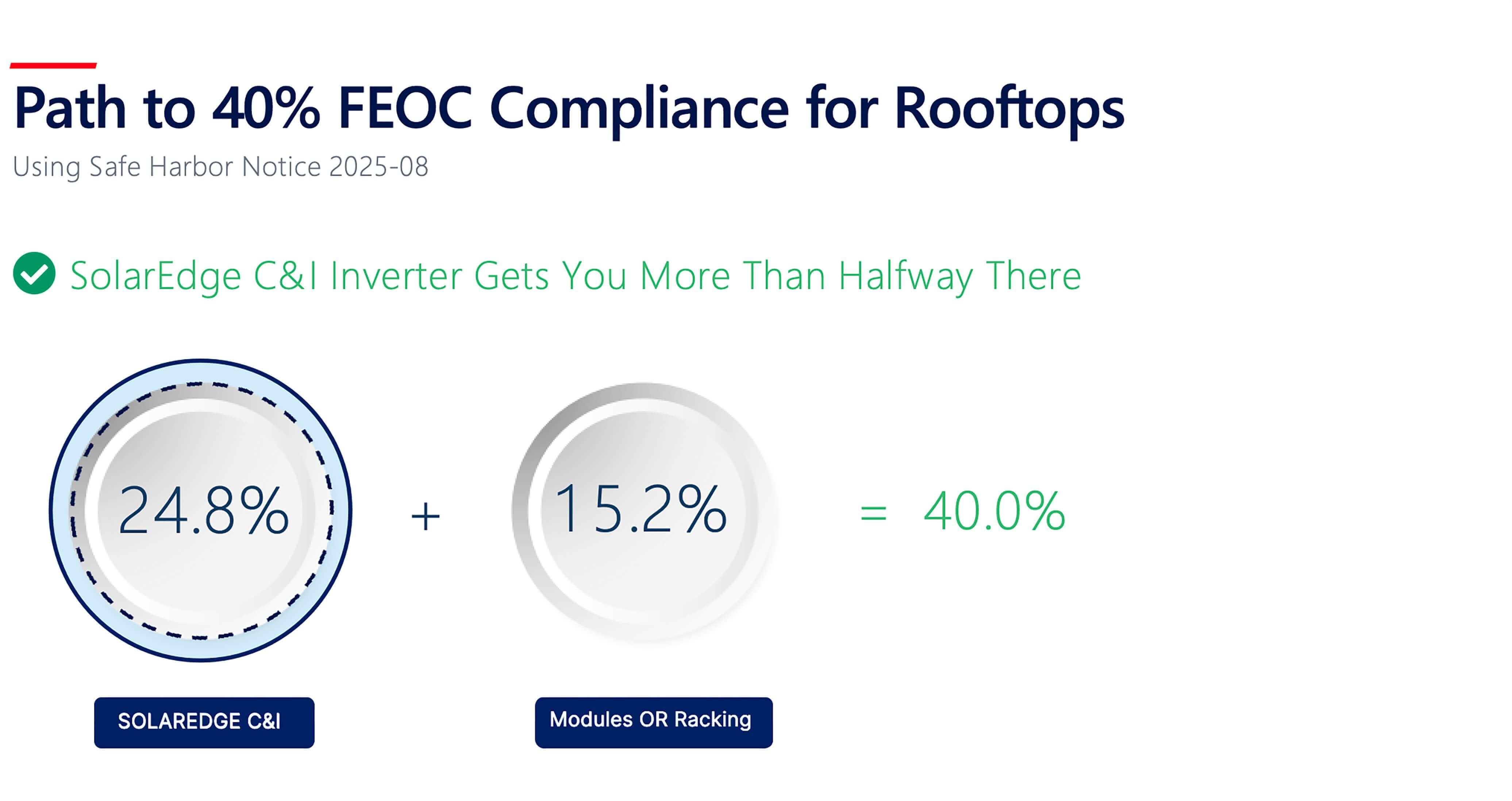
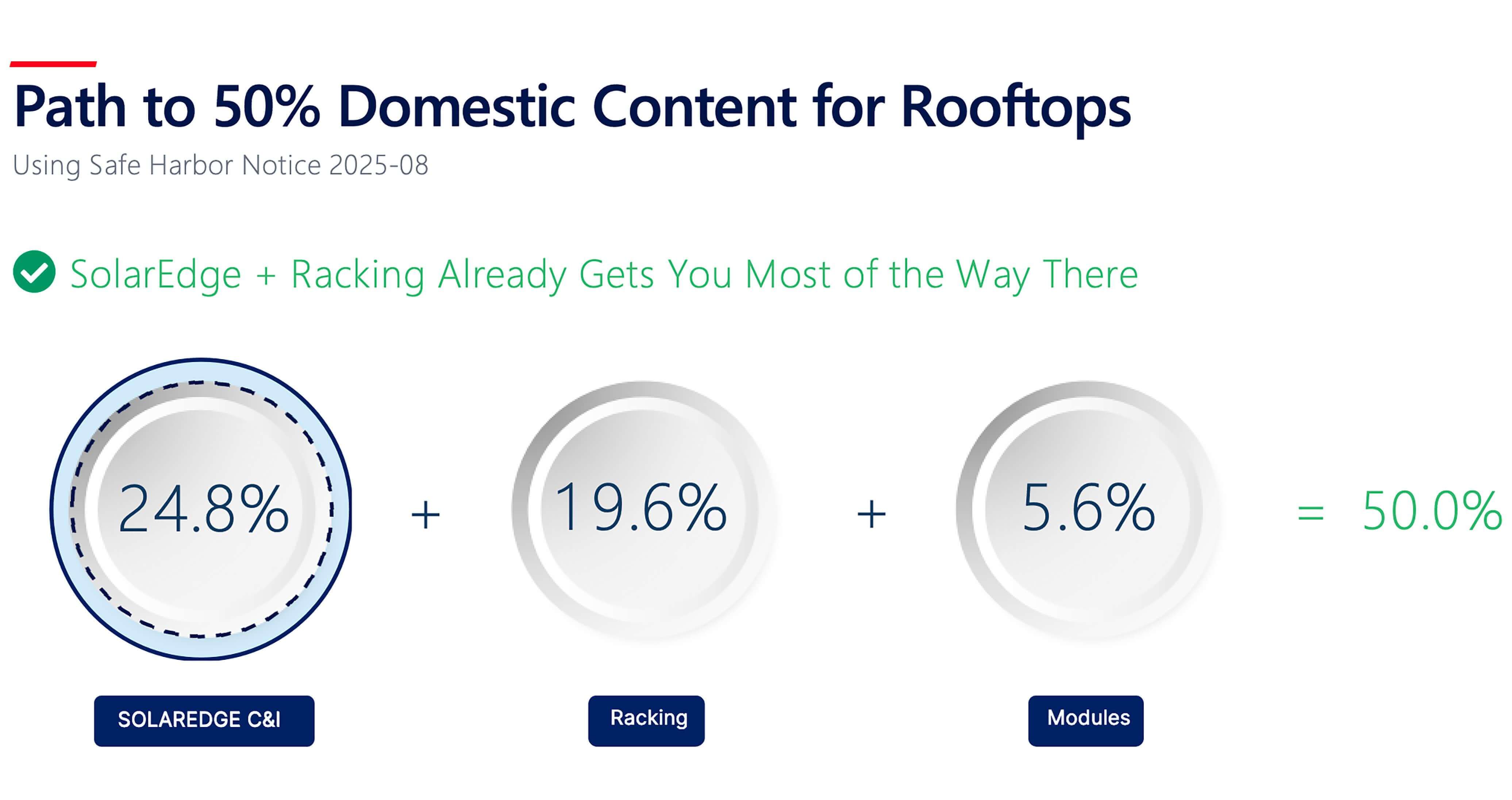
One of the most common concerns from developers is uncertainty about whether the domestic content and the MACR thresholds are actually achievable. The math for a standard C&I rooftop solar system — using IRS Notice 2025-08 safe harbor values and IRS Notice 2026-15 safe harbors — is more accessible than many expect:
| Component | Domestic Content Contribution | MACR Contribution | |
| SolarEdge Inverters / Power Optimizers | 24.8% | 24.8% | |
| Racking System | 19.6% | 19.6% | |
| Minimal Domestic Modules | 5.6% | — | |
| Total | 50.0% ✓ | 44.4% ✓ | Meets both 2026 thresholds |
SolarEdge inverters and Power Optimizers combined with a domestic content compliant racking system already exceed the 2026 MACR threshold without requiring specific module sourcing. The Domestic Content adder requires only minimal domestic module contribution — a gap achievable without complex supply chain restructuring.
SolarEdge is among the few known non-PFE inverter manufacturers able to supply non-PFE and domestic content C&I products. Manufacturing operations in Florida, Texas, and Utah mean the required certifications are available to customers — a compliance fact that directly impacts project ITC eligibility and the amount.
Frequently Asked Questions
Do the projects need to be named at the time the construction begins?
No need to designate a specific project site to begin construction — allocate your equipment across your pipeline later.
Can the 5% incurred cost be financed?
Yes. A loan can be used to fund the 5% incurred cost test, provided it is a true loan with proper documentation, involves a legitimate lender structure, and the taxpayer, EPC, or developer actually incurs the obligation. This is a real-obligation requirement, not a cash-on-hand requirement.
Does beginning construction on a storage project safe harbor the whole solar + storage project?
Where a solar + storage project is considered a single project, beginning construction on certain parts integral to both the solar and the storage sides of the project may be able to safe harbor the either the solar or the storage can qualify the entire project — PV and storage both. Whether the solar and storage are a single project is determined by evaluating single project factors in IRS Notice 2018-59.
The Bottom Line
July 4, 2026, isn't just a tax deadline — it's a business decision that will shape competitive positioning for years. The developers who act before that date will be locking in lower thresholds, a four-year completion runway, and the ability to bid projects with the benefit of 40% ITC. The ones who don't will be operating at a structural cost disadvantage on the same deals.
The window to lock in today's thresholds is narrowing. Don't get left behind.
Need help navigating the safe harbor process or understanding how SolarEdge products support your domestic content and FEOC compliance pathway? Our team works directly with developers to map the path forward.
Statements regarding tax credit eligibility, domestic content, and non-PFE compliance are based on current interpretations of applicable laws and guidance, which are subject to change. SolarEdge does not provide tax or legal advice. Consult your tax and legal advisors for project-specific guidance.