SolarEdge UL 3141 Power Control System (PCS)
Power export limit (PEL) at Commercial and Industrial scale
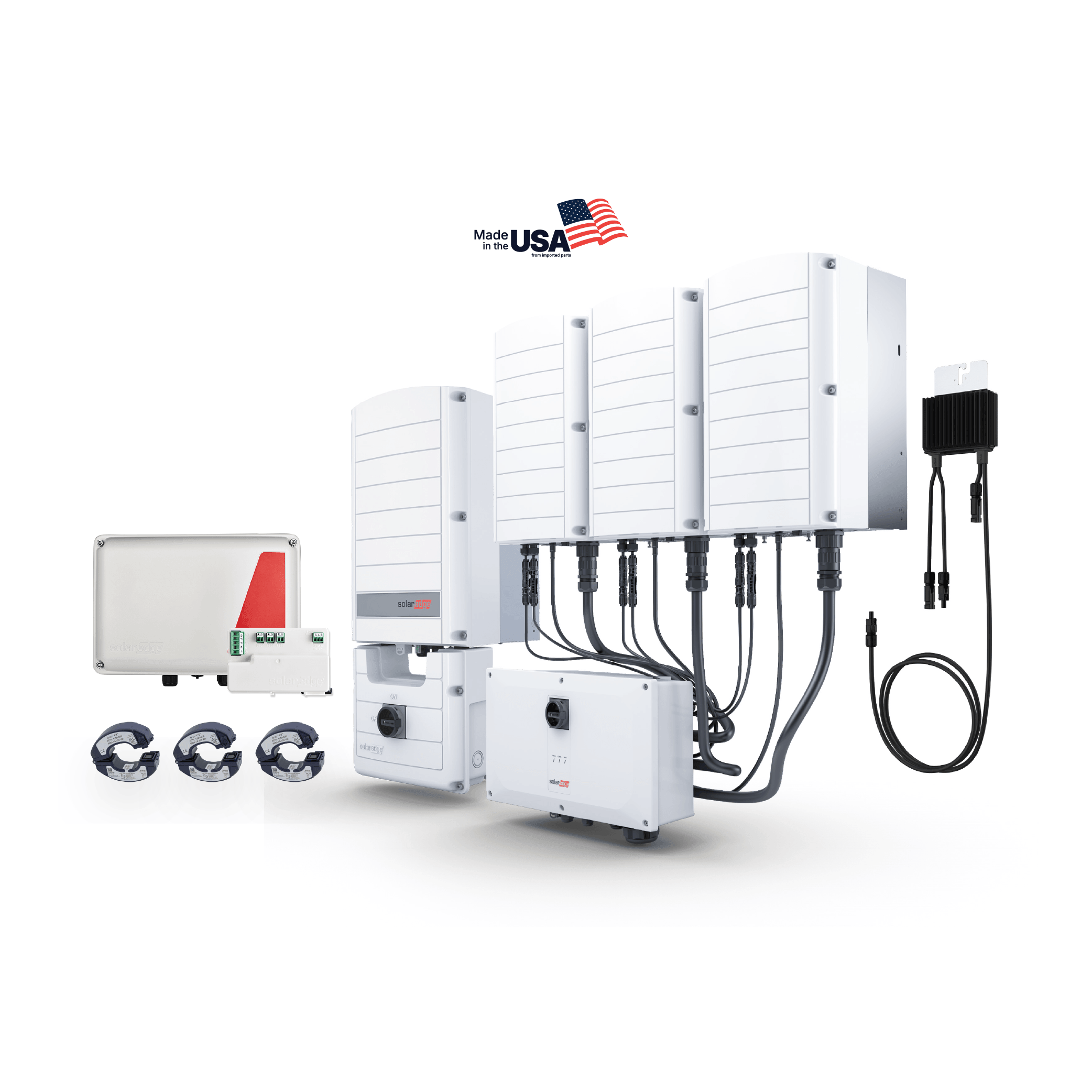
SolarEdge inverters, together with a compatible meter and current transformers (CTs), form a UL 3141 listed Power Control System for export limitation, built for commercial scale projects.
This solution controls at the Inverter Level and eliminates the need for costly equipment. UL 3141 control functions as a PEL. The system caps the net power your site can export to the grid in real time.
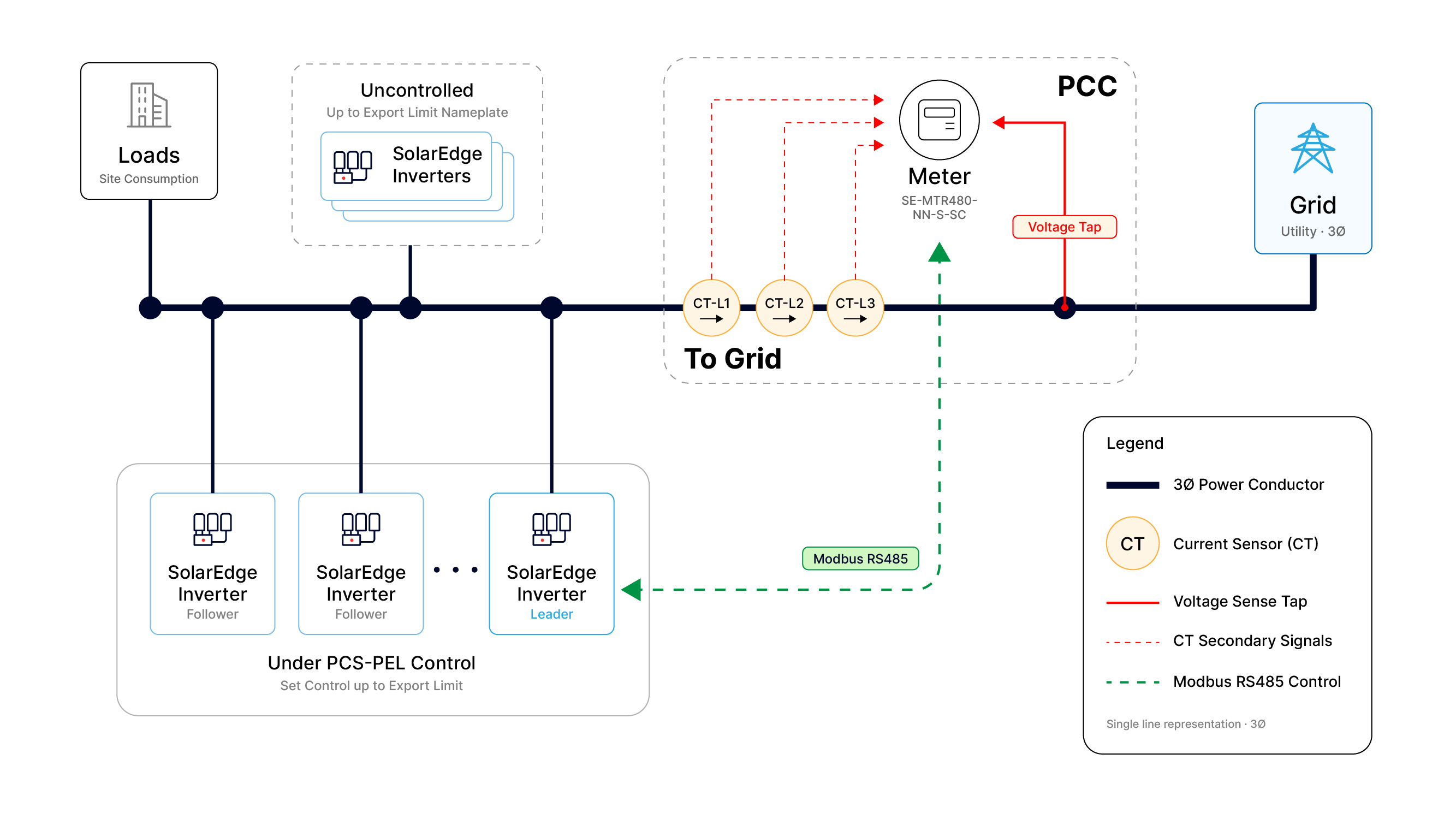
1. Meter at the Point of Common Coupling (PCC): A SolarEdge compatible import/export meter and CTs measure net power flow to the grid at the PCC.
2. Respond to load shifts: Inverters adjust production in real time to control power at or below the export limit.
3. Stay compliant: With Total or Per-Phase control across all phases automatically, with no manual reclosing or truck rolls.
Control is handled through the SolarEdge GO app; a "UL 3141 Compliant" indicator confirms the configuration. Only qualified personnel may enable non-export settings.

The meter and current transformers sense net flow at the PCC; SolarEdge inverters control power at the site, at or below the export limit.
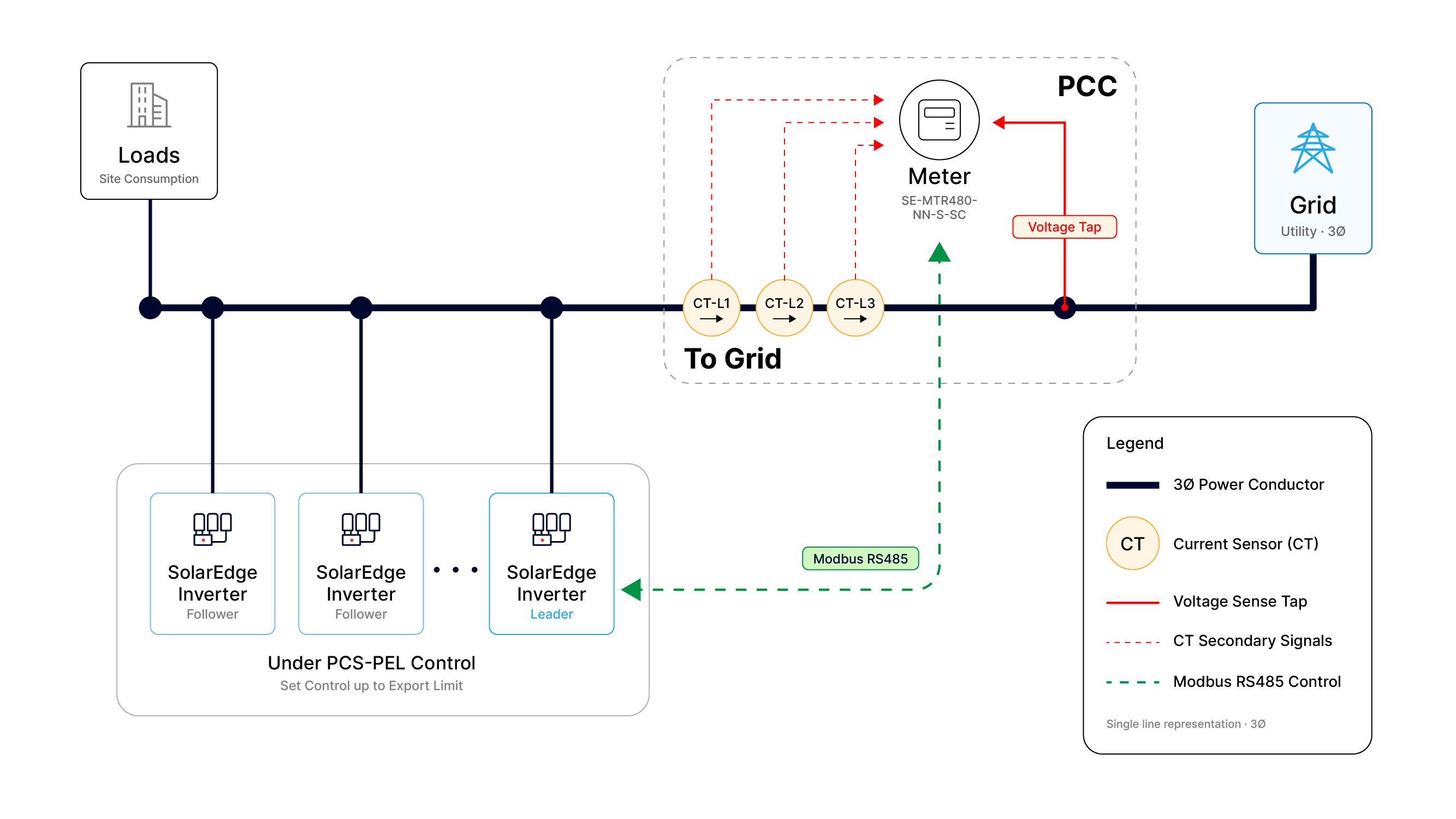
A listed, integrated system replaces the meters, relays, and custom programming a string-inverter PCS requires.
| Custom PCS with string inverters | UL 3141 PCS with SolarEdge | |
|---|---|---|
| Added hardware | Meter + CTs + special relay controls ($$$$) | SolarEdge Energy Meter + Third Party CTs |
| Programming | Custom programming ($$–$$$) | Standard configuration — no custom code |
| Commissioning | Bespoke commissioning & testing | Simple flow via SolarEdge GO |
| Utility approval | Slow — Non-listed system | Quick — UL 3141 listed |
Our UL 3141 PCS for Power Export Limiting integrates listed SolarEdge and third-party devices. It supports up to 10 inverters on the same bus, with a single meter.
| Component | Qty | Key details |
|---|---|---|
| Grid-Support Inverter — SolarEdge | Min. 1 | Synergy or Three-Phase Inverters; qualifying firmware (or newer) |
| Energy Meter — SolarEdge SE-MTR480-NN-S-SC | 1 | Must be configured as Import/Export type; 187–528 Vac, 55–65 Hz. Production/Consumption meter types will not perform PEL |
| Current Transformers — Socomec ACTL-1250-600 | 3 | Split-core CTs rated 600 A; UL 2808 listed; orientation-marked with arrows toward the PCC |
It performs Power Export Limiting (PEL). It caps the net power the site exports to the grid, in Total or Per-Phase mode, by limiting inverter production.
The current limit is 600A. We currently have configurations for 600A CTs. However, other ratings are coming soon.
No. UL 3141 listing here covers export limiting only. Local overload control (e.g., busbar protection under NEC 705.12) is a separate scope.
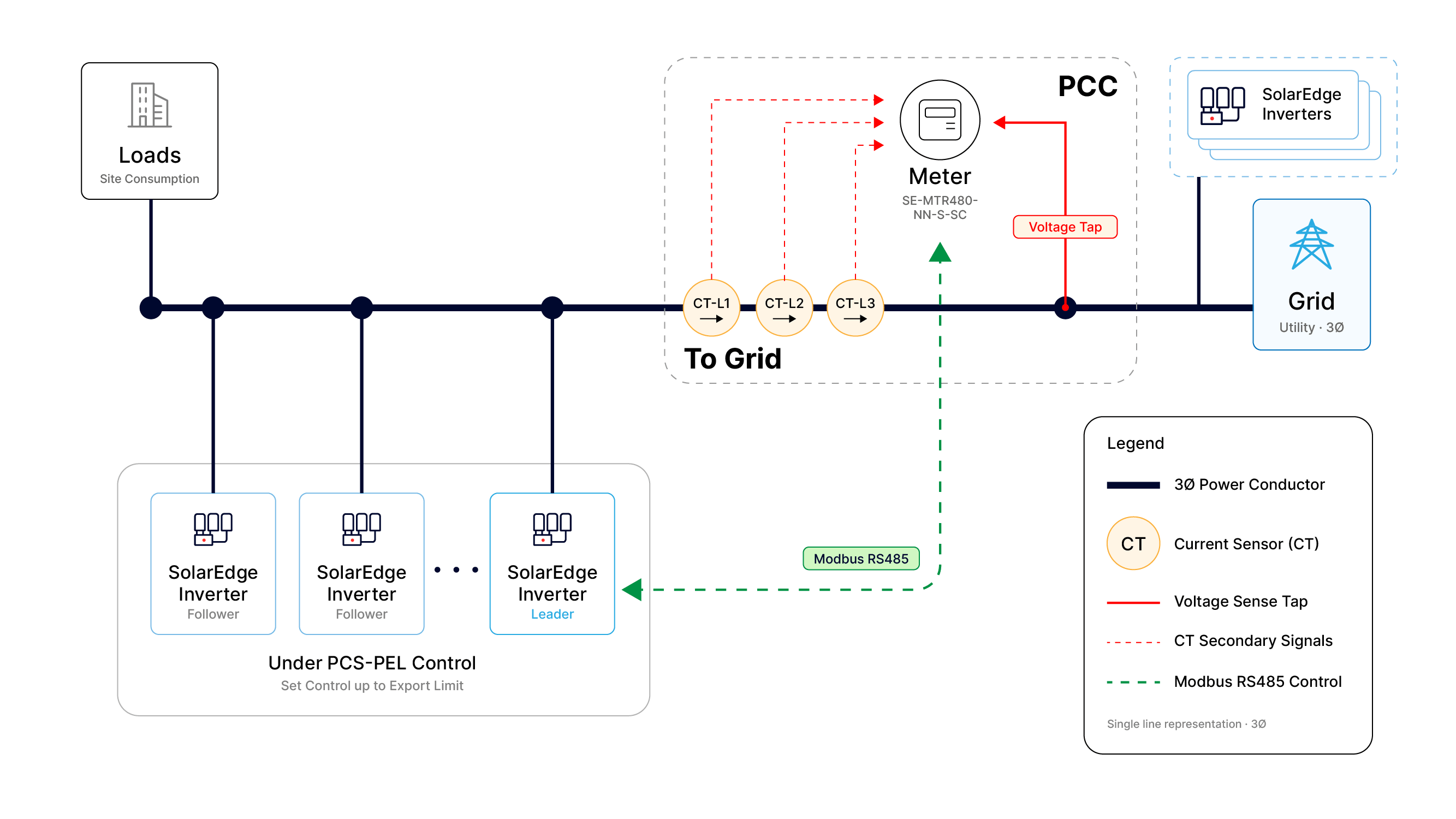
Configuration A suits a new site with a single branch of inverters; Configuration B fits a new site with multiple branches (one controlled, one uncontrolled); Configuration C adds new controlled PV to an existing site.
Setup and CT calibration are handled through the SolarEdge GO app, which confirms a “UL 3141 Compliant” indicator once the configuration is verified. Only qualified personnel may enable and implement non-export settings.
California is the leading market, where UL 3141 is desired for systems above 15 kW to avoid prevailing wage and qualify for the Rule 21 non-export fast-track. It's also becoming relevant in other states as utility companies realize the benefit of this feature – Massachusetts, Connecticut, New York, Colorado, Oregon, and New Mexico. Markets pursuing commercial solar where interconnection is slow and demand charges are high.